Showing posts with label DDB NZ. Show all posts

Sep 9, 2011

9/11 & Advertising Exploitation

Continuing on from my previous 9/11-themed blog post, here's a look at some of the more sinister examples of advertising which exploited the tragedy of the event and its global impact. It seems advertisers just can't seem to stay away from the iconic imagery of the twin towers of the World Trade Center (WTC) in lower Manhattan, New York City.


USA Discounters
Ad Agency: Levenson and Hill, Dallas.

Here is a recent example of 9/11 themed advertising for USA Discounters. USA Discounters is a not-so-popular credit store that "has been serving all military and government employees since May 1991." The towering body copy is the Declaration of Independence.

The tagline reads "The things we stand for still stand".

What a tacky ten year anniversary.


Khaleej Times, Dubai.

On the anniversary of 9/11 in 2007, the Khaleej Times,"the No. 1 English language daily paper published in Dubai, United Arab Emirates," employed a cheap visual trick in this full page anti-smoking ad. The headline message reads "5.4 million people die of smoking related causes every year. That's 2000 times a 9/11."


ASH (Action for Smoking Health)
Ad Agency: DDB NZ
Another cigarrette / tower visual theme was used by DDB NZ for ASH (Action for Smoking Health). This New Zealand based ad is almost a direct rip-off of the Khaleej Times ad which came out a year earlier in Dubai.

Why not go a step further and have a sky blue colored lighter - with an airplane graphic on its side, coming in sideways lighting up the cigarette towers. Little pieces of ash could be added - floating off the top to represent the WTC victims who jumped to their death.

If you don't quit smoking, will that be a victory to the terrorists?

We get it. Smoking kills. But it is really necessary to present the message this way?


"Titanic", Solidarités
Ad Agency: BBDP & FILS, Paris, France.
French humanitarian organization, Solidarités, exploits TWO tragedies for its global health hazard - "non-drinking water." The goofy diorama equation of a sinking Titanic plus the twin towers - complete with paper cut out passenger planes looming, multiplied by 2000 (couldn't they find another world-famous tragedy where 2000 people died?) equals a glass of dirty, lethal non-drinking water.

Ad agency, BBDP & FILS, also produced a TV / digital ad for the campaign - complete with an odd, floating, drifty music box type background music.


I'm no math genius, but something in that insensitive sum just doesn't add up!


Courrier International
Ad Agency: Saatchi & Saatchi, France.
Another 9/11 print ad from France - this one for Paris-based weekly, Courrier International. With the tagline   "Learn to anticipate", the geniuses at Saatchi & Saatchi France have miraculously solved the tragedy by concluding that the WTC architects could have saved lives by only building the twin towers to about 50 floors.

Sacré bleu! The hijacked planes completely miss their target, each other and the ad misses any semblance of common sense and dignity.


El Pais, Spain
Ad Agency: Ogilvy and Mather, Colombia.

It's all fun & games for Spain's largest national newspaper, El Pais. The double page ad offers a challenge to Spanish readers to spot the mistakes in this 9/11 image. For instance - did you know that the initial tower was hit much further up, the second plane to hit the WTC was not a Hercules military transport plane and the Transamerica Pyramid is in San Francisco not New York?

Yes. There is something wrong with this picture. But it's not just the photoshopping.


The Moscow News, Russia
Ad Agency: BBDO Moscow
Another 9/11 exploitation ad for another national newspaper, this one is Russian weekly, The Moscow News. This is the most artistically crafted 9/11 depiction of the bunch. A digital papercraft recreation of the exploding WTC towers.

Not artistically offensive enough for you? There's also a Hiroshima version of this ad.


"Tsunami", World Wildlife Fund
DDB Brasil, Brazil
And finally, what I consider to be the pièce de résistance of 9/11 exploitation advertising over the last decade. DDB Brazil decided to mock up this print ad (allegedly without the consent of their client - the World Wildlife Fund).

A broadcast version of the "Tsunami" ad was also produced.


The message in these ads, once again reduces the 9/11 tragedy to the number of deaths. After recreating the event digitally and then adding extra passenger jets, the ad claims:

"In 2005, the tsunami killed 280,000 people.
That's 100 times more deaths.
Our planet is brutally powerful.
Respect it.
Conserve it."

After presenting the campaign idea to the client, the World Wildlife Fund or WWF, (where it was summarily rejected), the agency secretly ran the print version of the ad in a small Sao Paulo newspaper. This was so the campaign could then be entered into advertising awards shows such as the One Show event in 2009.

Read the story of the full schemozzle of a SNAFU here.

Ultimately, the group of creatives at DDB Brasil were so enamoured with their campaign, they lost sight of the fact they were comparing a man-made global terrorist act with an act of nature. Both were catastrophic yet incomparable. Going behind the back of the WWF so it could be award show eligible scaled the depths of poor taste to serve narrow-minded egos.


It is quite clear from all of these ads (notice how the majority are from agencies outside North America) that the use of 9/11 imagery without any sensibility or empathy has only shown to exploit the event. People might equate it to anti-American sentiment abroad, but ultimately it's poor judgement and decision making by the creative directors who signed it off.

May 21, 2011

Guerrilla in the Midst
- Several Great Guerrilla Advertising Examples Pt I


Guerrilla Advertising (also known as "guerrilla marketing" or "ambient advertising") is a fairly recent innovation in the advertising world. It involves unusual approaches such as staged encounters in public places - usually built into the physical environment. It can also incorporate interactive advertising, where the viewer can respond to become part of the advertising message.

Guerrilla as an advertising medium is becoming a more popular avenue for advertisers on a low budget, to reach consumers and a target audience in unpredictable and innovative ways.

Here is a look at several great outdoor guerrilla examples from around the globe. 


Scotch Brite Street Drinking Fountain, Bangkok, Thailand, 2009.
Y+R Thailand were asked to show Scotch Brite's super absorbent unique selling proposition. A novel way of presenting this to consumers was to build a street fountain with the sink component made completely out of the super absorbent sponge. These were set up all around the city of Bangkok, Thailand. Whenever a tap was used, the consumer saw a clear and effective demonstration of it's super absorbency. This resulted in increased product "buzz", awareness and ultimately sales.


Feed SA Shopping Trolley, South Africa
Feed SA is a charity dedicated to feeding disadvantaged people throughout South Africa. TBWA/Hunt/Lascaris developed decals depicting hungry, begging street children - placed at the bottom of supermarket shopping trolleys ( or carts) bearing the Feed SA website and the line:

 "See how easy feeding the hungry can be?"

Any food placed in the trolley appeared to be given to the child. The message was seen by hundreds of shoppers throughout South Africa for the low cost of mass produced but well designed decals. The result was a marked increase in website traffic and donations.


Cingular Billboard, New York City, 2006.
In 2006, Cingular (via BBDO NY) showcased a dramatic way to highlight the issue of dropped calls. Setting up a large billboard in Times Square, New York City, a special segment was installed on the ground below. The sign proved so popular that people walking by and tourists posed with it and took pictures. Does that mean it was a viral billboard?


3M Security Glass, Canada
Rethink Communications Vancouver found a creative way for 3M to illustrate the strength of its security glass in Canada. In selected metropolitan bus stops, a window filled with bundles of cash bills was encased inside 3M security glass. The money was real but was only $500 in value (small denomination of bills). Security guards were also present in these locations. Passers-by were encouraged to try and break the glass with their hands and feet. 

The ad took a beating but still managed to sell its point.


Superette: Thigh Advertising, New Zealand
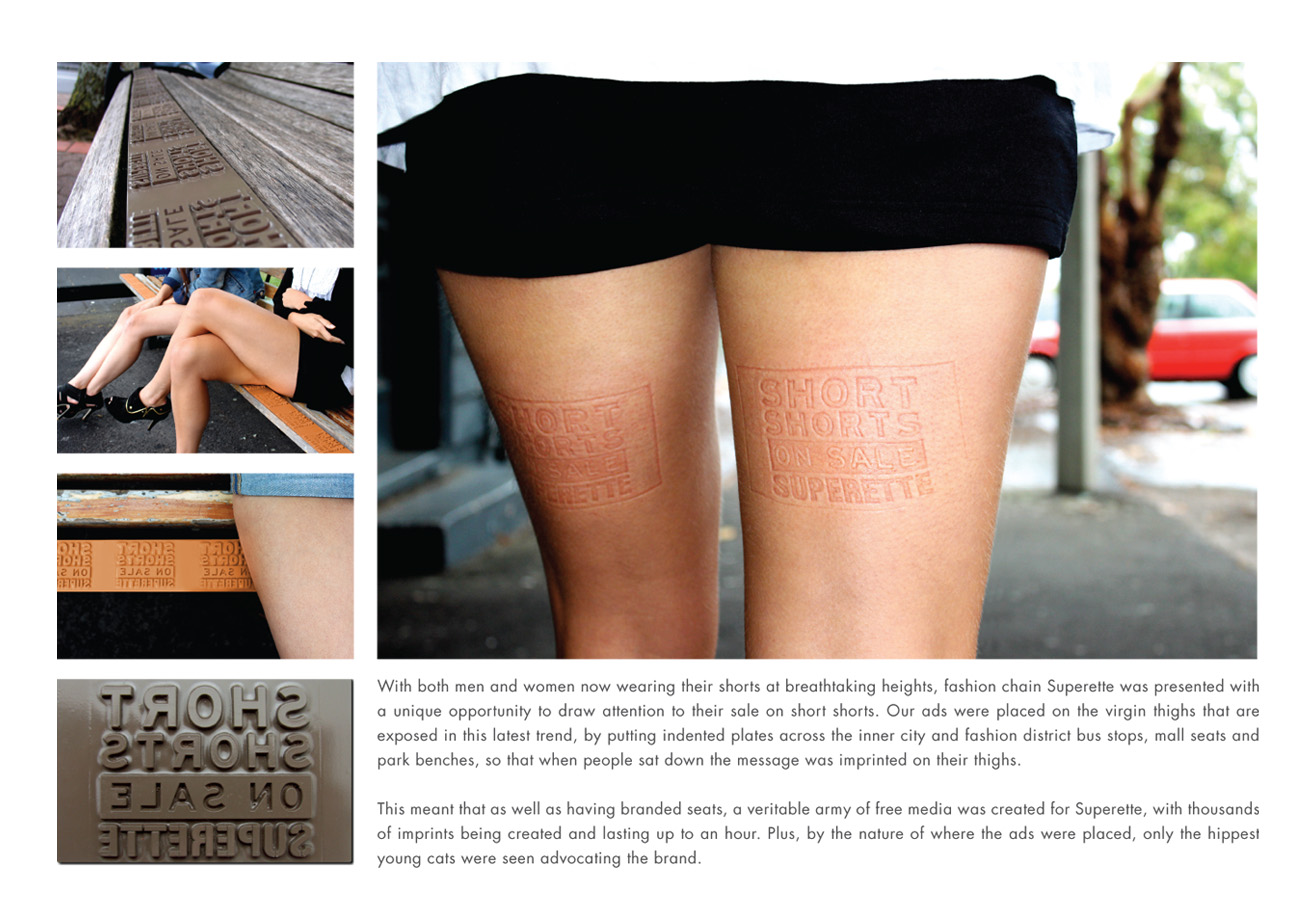
New Zealand fashion chain Superette turned to DDB NZ for a promotion on their seasonal sale of short shorts. The agency came up with a controversial but effective method to spread the word. Indented and reversed plates were placed across inner city and fashion district bus stops, mall seats and park benches so that when people sat down, the message was imprinted on to the back of their thighs.

Not only were the reverse ads on seats but also readable on thousands of imprints on the back of people's thighs - which lasted up to an hour. The strategic placement (both by seat location and the fact that the sitter had to be wearing short shorts or a short skirt) meant that only a targetted selection of people would be displaying the sale message.

Did the Superette campaign go too far?


I came across many great examples of guerrilla advertising and will be adding to this in a later blog post.

For more samples, check out  Creative Guerrilla Marketing (I have added this to my "Interesting Advertising Links" list on the right).

Do you have any favorite examples of guerrilla advertising?