Showing posts with label Billboard. Show all posts

Aug 17, 2011

Not All Pun & Games: Kenneth Cole
- A Case Study In Bad Copywriting.


New Yorkers are becoming numbingly familiar with various Kenneth Cole billboards and outdoor advertising that feature around the city.

For the last decade, these ads - written by Kenneth Cole himself, attempt to convey the fashion brand as something beyond a mere clothing line. In an attempt to link the brand to current social issues and events, Cole may be doing more harm than good.

A well-known rule of thumb in the school of copywriting is - if you're going to use puns, make sure they are good ones - otherwise, they should be avoided at all costs. Cole's ads are becoming so poorly regarded in the advertising industry, one popular ad blogger has dubbed him "The Worst Copywriter in the History of Advertising™."


So where do we start?

Shortly after 9/11 - when New York (and the U.S.) was still in shock at the horror and devastation from the tragedy, Cole placed a billboard around the city with the line:

GOD DRESS AMERICA

A second billboard shortly following this read:

"On Sept. 12th, families returned to the dining room table.
TODAY IS NOT A DRESS REHEARSAL."

I couldn't find images of these billboards (if anyone can find an image, please let me know and I'll update this).


Post-Hurricane Katrina, Cole looks to find an upside.


Photo by Bucky Turko

By 2006, Cole attempted to address the issue of NYC's homeless with this little gem. Did the homeless people walking by this sign along with other New Yorkers find this re-pulsive?


In 2007, when the Iraq War and the search for Weapons of Mass Destruction had been dominating the airwaves, Cole had something to offer. The play on words - to "Weapons of Mass Distraction", by this stage, was older than the hills. This is one WMD that was better off staying hidden.


Riding the Obama wave of hope late in 2008, Cole makes a new precedent in stooping to low puns.


2009 would prove to be a bumper crop year for bad Cole punnage.


The American economy hit a severe slump and many became worried about keeping their jobs and paying bills.


But Cole still managed to find a way to appeal to those who are more concerned about their clothing than their country.


In winter of that year, Cole shoehorned his brand into the miraculous landing of a passenger flight on the Hudson.


Were people warming up to Cole's punnery or was it polluting the ad-mosphere?


In early 2011, riding the coat tails of the Arab Spring, Cole made a tweet that was less than appropriate about the uprising in Egypt.


After grabbing the desired headlines and free publicity, the predictable apology was summarily delivered.


Most recently, Cole has attempted to latch his brand on to the Gay Rights movement.


As well as war or American foreign military involvement. This wordplay borrows from one of Bertrand Russell's famous quotes, "War doesn't determine who's right, only who's left".


While a lot of these lines are hit and miss - in my opinion, the majority fall in the "miss" column. I believe many see it as a shameless attempt to attach a brand to social causes and while there's nothing wrong with doing that, the methods (or lines) Cole employs, lowers the bar.

I'm guessing Kenneth Cole never went to ad school or honed his skills in an ad agency. If he did, I suspect the initial feedback he'd receive from a junior copywriter would be to avoid the bad puns and that his strategy is showing and is a little too obvious in plain sight. Puns tend to be tacky and debase the product or service they are attempting to promote.

Here's a social cause other fashion advertisers might want to get behind - eliminating bad advertising and poor copywriting puns.

Jun 1, 2011

Naomi Campbell out-diva's Cadbury's "Diva" Bliss Chocolate

We've all heard the stories.

Naomi Campbell, world reknowned supermodel and diva extraordinaire, has a history of being difficult to work with. Her reputation precedes her when it comes to her shrift and short temper.

What you get when you google image search "Naomi Campbell Chocolate."


So it was only natural when Cadbury decided to launch a campaign for its new, luxuriously rich line of gourmet dairy milk chocolate bar, "Bliss", that it decided to compare its diva quality with that of Naomi.


Launched in supermarkets and newspapers in the UK by ad agency Fallon London, the ad leads with the headline,

"Move over Naomi, there's a new diva in town."

The wrapped chocolate bar sits in a pool of diamonds (which some compare to the controversy linking Naomi to the "Blood Diamond" case in which she had to testify). The ad then states, "I'm the world's most pampered bar."

Naturally, this comparison left a bitter taste in Campbell's mouth and sent her into a tantrum. She blasted Cadbury and the ad on grounds that it was racist. She stated that she is looking at, "every option available" including legal action.

Not A Happy Campbell
Naomi feels certain that its the color of her skin thats being described, and not her diva-style tantrums or supermodel lifestyle that she lives. She did not see the humor in the ad and found it insulting and hurtful.

The campaign also received a response from Simon Woolley of Operation Black Vote, who responded to the drama with his own criticism.

In response, Cadbury pulled the advertising with no plans to repeat the ad.

Whether the campaign was racist or not is open to debate. Personally, I feel that the company was playing up on Noami's reputation and not her race.

But I just wonder why Cadbury had to shelve and mothball the whole campaign. Surely they could have found another "diva" to help sell their chocolate - maybe with a method or angle that isn't so combative. 

Alternatively, if it was really only a one piece campaign that wasn't terribly extendable in its execution, maybe it was just easier to scrap the whole thing.

If Cadbury weather the lawsuits without any major compensation or legal bills, at least they managed to raise the profile of their product through some controversial free publicity (including this very blog entry).

May 31, 2011

Does Wonderbra lift and separate from the other handful of bra brands?

Over the last few years, there's been a particular branding campaign which has captured my gaze.

Even though the campaign isn't directed at me, I still notice these ads and can't look away.

"DD", Saatchi & Saatchi, 2006, 

Wonderbra is a lingerie company that's been around for most of the last century but really only uplifted its name globally in the 1990's. They differentiated themselves as the bra brand which not only enhances a woman's bust line but makes heads turn.

"Hello Boys", TBWA, 1994.


A controversial print / poster / billboard outdoor ad campaign by TBWA in 1994, with Eva Herzigova, kicked off this new creative strategy which spanned the globe and covered numerous different ad agencies.

But over the last decade, the branding campaign switched focus to a strategy where the ads displayed don't show the cleavage being enhanced but the results and consequences.

Focussing on the outcome rather than the eye-grabbing spectacle of the bras themselves, the campaign lets the viewer make the connection.

Some of these are rather obvious while others are more subtle and make you think.


"Shoes", Saatchi & Saatchi Singapore, 2002.
This ad caught my eye in a creative advertising magazine. It may not be apparent at first, but I think it works on two levels. The woman in the ad can't see her feet because she's wearing a Wonderbra. So she's unaware of the mismatched shoes. I also thought that no one else on the street notices her shoes as they are all looking at the woman's cleavage (not shown).


"Umbrella", Publicis, Paris, France, 2007.
It takes a while for some people to get this one.

It's not the vacant outdoor courtyard. Or the number of shopping bags.

(What's holding the umbrella?)


"Friends", Publicis, France, 2009.
A more obvious one but still direct and simple.


"Baby", possible spec work / mock ad.
This one is both funny and creepy at the same time. I can't seem to find an agency source for this ad which makes me think it may be a spec or mock / parody.


"Scooter", TBWA Praha, Czech Republic.
Not so subtle but still lets the viewer make the leap by the way the image has been cropped below the chest line.


"Economist", DDB Worldwide, Singapore.
This ad parodies the well-known,  long-running outdoor campaign for The Economist which is "written by intellectuals for intellectuals."

Some people have criticized this ad regarding its intention. Is the Wonderbra wearer quoted ("Linda Foster, CEO, aged 29") too smart for The Economist? Or is she not smart enough? Is it because she shows cleavage that she doesn't have to be smart to get where she wants? Is every man at her beck-and-call?

Or is it more simply that the bra works so well that the wearer can't see below it to read a magazine like "The Economist"?

I think the final suggestion is the idea DDB were trying to get across with this ad but some read it differently.


"Oranges", Copy: "Fits Naturally",  possible spec work / mock ad.
I couldn't find an agency reference for this ad so it may be another spec or mock ad. The oranges being a metaphor for the perfect "natural fit".


"Pants", possible spec work / mock ad.
Another possible spec / parody. The sheer number of these add to the brand as they are spread virally, but may be beyond the control of the Wonderbra company.


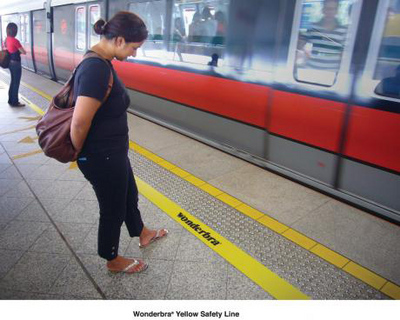
"Yellow Safety Line", Guerrilla Advertising, Euro RSCG, Singapore, 2008.
Interesting guerrilla placement by Euro RSCG Singapore - adding a second yellow safety line futher behind the regular line at public train stations in Singapore.


There has been criticism by some advertisers of Wonderbra's campaign in that it may not speak directly to its target audience of women. Some say that these ads have been designed by advertisers (predominantly men) for other advertisers (other men).

I don't agree with that entirely and I guess it differs from ad to ad. They do have a consistent visual element without the use of copy to convey their idea. It unhooks the viewer's mind to make the connection - that last step of "the big idea".

I've been meaning to cover this campaign in my blog for a while, so I'm glad to be finally getting this post off my chest (sorry for the pun/s... lol).

May 26, 2011

What's Up the Tri-Cities Health Board's Butt?

I had to dig a little to find this story.

A recent Colon Cancer Awareness campaign for the American Cancer Society was launched successfully in the southeastern region of Washington State. Running since last summer, the Yakima Health Department gave the campaign an approval to go ahead.

Billboard for Colon Cancer Awareness, Will Bryan Design.
Created by Will Bryan Design, the public awareness campaign is for the National Colorectal Roundtable and specifically targets the older demographic in rural communities of WA.

It comprises billboards, postcards, print and radio ads which run on the line:
"What's up your butt?"

Poster for Colon Cancer Awareness, Will Bryan Design


The visual components are accompanied by pictures of people with pained or shocked expressions on their faces. The senior citizens targetted, are prompted to get rectal examinations to check for colon cancer to help detect and treat the preventable disease.


Everything was running smoothly until earlier this week when the adjoining Tri-Cities and Benton Franklin Health Department reared up and blocked the campaign from appearing in its districts. This is despite the unanimous approval to extend the campaign's reach by the very same board just one month ago.

Probing further into this story, no reason was offered for the about face. A local survey showed 66 percent of people who saw the billboards reacted positively.

Personally, I believe the Tri-Cities Health Department are being a little too anal in rejecting this poll analysis. Frankly, it shows them to be acting very backward looking - and not in a good way.

I don't see what the big fuss is about a head-turning headline and a few innocent wordplays. The residents of southeast Washington should push for a better result.

It may very well save somebody's life.